- Kreatio
- Posts
- When Flawless Becomes Forgettable
When Flawless Becomes Forgettable
Why perfection sedates the mind and flaws spark innovation.

V.C. Hanna
November 12, 2025

INSPIRING QUOTE
Symmetry Sedates, Asymmetry Awakens
A London butcher’s son stares at Velázquez’s serene painting of the Pope.
He doesn’t copy it. He corrupts it.
Francis Bacon paints the Pope screaming inside a glass box. The Pope’s face melts into anguish as streaks of raw meat red tear through the air.
Galleries recoil. “Obscene!” critics claim.
And yet, Bacon’s screaming popes become icons of 20th-century art. Decades later a couple sell for over $50 million each.
Centuries earlier, another Francis Bacon (coincidence?) wrote that beauty requires strangeness:
“There is no exquisite beauty without some strangeness in the proportions.”
The painter proved it through distortion; the philosopher meant it through proportion.
 Spanish painter Diego Velázquez’s ‘Portrait of Pope Innocent X’. c. 1650 | 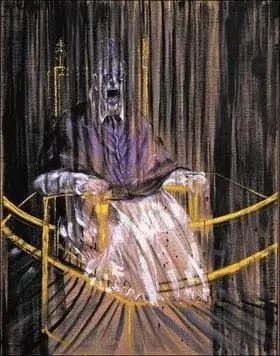 One of nearly 50 “screaming pope” paintings by Francis Bacon. c. 1953 |
Both Bacons revealed the same paradox: perfection is pleasant, but not captivating.
Psychologists have confirmed that the brain glides over symmetry. Perfect harmony requires little effort to process, so it’s forgotten quickly. But asymmetry through a slight distortion, an unexpected color, a crooked smile awakens the mind. It breaks the brain’s autopilot and demands attention.
Creativity works the same way. A flawless design sedates; a flawed one sparks.
Perfection pleases the eye, but imperfection moves the mind.”
It’s why a mismatched font on a slide can jolt an audience awake, or why a note that bends just off-key can make a song ache in all the right ways. In a world of polished sameness from AI-perfect logos to templated feeds and optimized everything, strangeness is not risk. It’s strategy.
It’s how you make something alive.
And this idea isn’t just philosophical, it’s been practiced for centuries, from tea ceremonies in Kyoto to boardrooms in Seattle.

CREATIVITY SPOTLIGHT
The Ugly Draft: From Cracked Bowl to Trillion-Dollar Decisions
Kyoto, 16th century.
A tea master lifts a celadon bowl to his lips. It slips.
A hairline fracture spiders across the glaze.
Servants flinch, readying to toss it.
The master halts them.
He sends the shard to a kintsugi artisan.
Molten gold is poured into the wound; the fracture glows as it cools.
The bowl returns not repaired but reborn, its golden seams whispering, “I am broken, and that is my beauty.”
Collectors begin paying fortunes for such imperfections.
This is Wabi-sabi: the belief that beauty deepens with irregularity, because it carries the trace of its becoming.
 Ceramic piece with the golden seams of kintsugi. |  A work embodying the wabi-sabi aesthetic. |
💡 Kyoto to the Bay
Fast-forward to Seattle, 2004.
Jeff Bezos walks into a boardroom overlooking the city’s skyline and slaps a rule on the table: No PowerPoint. Ever. Instead, every meeting begins with a narrative-style memo: six pages, single-spaced, font size 10, no bullet points, no charts.
The first draft, riddled with typos and tangents, is messy, fragmented and half-formed, but alive.
But then, the work to create more value begins.
💡 The Gold in the Cracks
Like the kintsugi artisan tracing gold along a fracture, the team interrogates the mess.
A vague claim gets circled in red: “Where’s the data?”
A leap in reasoning gets a bracket: “Connect these dots.”
A margin note sparks a tangent that turns into an innovation.
And when page 2 jams in the printer, it raises another idea: “Should we sell Amazon branded printers and ink?” Seriously, Amazon, are you reading?
In design, the imperfection might be a deliberately uneven layout that feels more human than the AI-perfect version.
In storytelling, the imperfection might be a line that breaks the rhythm but feels true.
By the final read, the flaws are refined. The memo, reinforced with clarity, emerges not perfect, but powerful.
Amazon’s biggest bets—Prime, AWS, one-click—were all developed this way, inside pages that first looked imperfect.
💡 What Wabi-sabi and Bezos Teach Us
Ugliness is the entry point, not a bug, but a feature.
The “fix” doesn’t hide the flaw; it reinforces it with gold.
Imperfection signals authenticity, and authenticity builds trust.
Each visible repair strengthens both the work and its maker.
Wabi-sabi is a difficult concept to define. One common definition is: the appreciation of beauty that is "imperfect, impermanent, and incomplete".
When you embrace the ugly first draft, you accelerate mastery because beauty isn’t found in polish, but in persistence.
BLINKS, THINKS & LINKS

Curiosity Candy
Jeff Bezos’ annual letters to shareholders gives us a glimpse into how he likes staff to prepare communications.
The history of ‘wabi-sabi’ and the acceptance of the somewhat broken and the imperfect..
Wabi-sabi is a philosophy, and kintsugi is an art form that acts as a physical manifestation of that philosophy. An intro video on how the art of kintsugi.
ACTIONABLE PROMPTS

The Flawed First
Look at a project you’re polishing: a memo, post, pitch, design, or product. A perfect option would be one you’re over-editing.
A small irregularity— a rough sentence, a visible brushstroke, a mismatched font, a weird analogy— can make something stick.
Now consider one of those irregularities and deliberately expose one imperfection instead of hiding it.
Ask: Could this flaw actually make it more memorable or human?
If yes, highlight this one imperfection that secretly gives it life. And leave it there on purpose.
Don’t erase that tension, trace it in gold.
Thanks for reading,
V.C. Hanna
Founder, Kreatio
